Why I Choose Bolt Action: A Wargamer’s Perspective
Every wargamer has an origin story. Mine starts the way a lot of them do: a few friends, a borrowed table, and absolutely no terrain.
Shot to Pieces and Hooked
Sometime in high school, somewhere between 1999 and 2004, my friends sat me down in the back room of a his grandma’s house for my first game of Warhammer Fantasy. They played Empire. I was handed the Orcs. The battle plan, as it was explained to me, was simple: line up across the table and march straight at their lines.
I got shot to pieces. I was also completely hooked.
We spent years after that playing Warhammer 40,000 and Warhammer Fantasy. Eventually I branched out into other games, now playing Stargrave, Dracula’s America, The Silver Bayonet and SAGA along with many others. But the one that really stuck was Bolt Action.
First Hits Free
The credit goes to my friend Alex, the same friend who got me into wargaming in the first place. He was the first in our group to step away from Games Workshop, and when he picked up Bolt Action, he figured it was right up my alley. I’ve always loved history, so he gifted me a box of Soviet infantry, and away we went.
I honestly can’t remember my first game, other than that it was against Alex. What I do know is that I never looked back.
Why the Second World War?
I’ve always been drawn to WWII, and not just the battles. What fascinates me most is the impact the war had on everyday lives, and how it reshaped the entire world. There’s a clear line between the pre-war world and the post-war world, and almost everything on the far side of that line was touched by it in some way.
That said, I’m careful about how I approach it. I don’t want to turn real people’s experiences into a game. For me, building and playing these forces is a way to honor their memory and to learn what they went through.
History on the Tabletop
My background is in history and library science, and it absolutely shapes how I approach the hobby. For me, the hook usually comes from a documentary or a book about a particular campaign or battle. That sends me down the rabbit hole of researching the units that were actually there, and then figuring out the best way to represent them on the table.
I think of historical tabletop gaming as a kind of public history. Put a well-painted table of WWII miniatures in a game store and people come over and ask questions. When they do, I want to know what I’m playing and be able to tell them the story behind it.
My Armies
These days I’m spread across a few Theaters:
- Italians fighting in Italy, Albania and Greece
- Germans on the Eastern Front
- US Marines in the Marianas
- Chindits deep behind Japanese lines in Burma
- British Paratroopers, currently on the painting desk
- France, focused on the Battle of France
My favorite right now is the Italians. It’s the force I’ve spent the most time on, and the one where I really pushed myself to do a good job painting. They’re also a lot of fun to play. Aside from those, I also have a Japanese Army I’m planning on building and painting, along with a Thai Army I’d like to create a ruleset for.
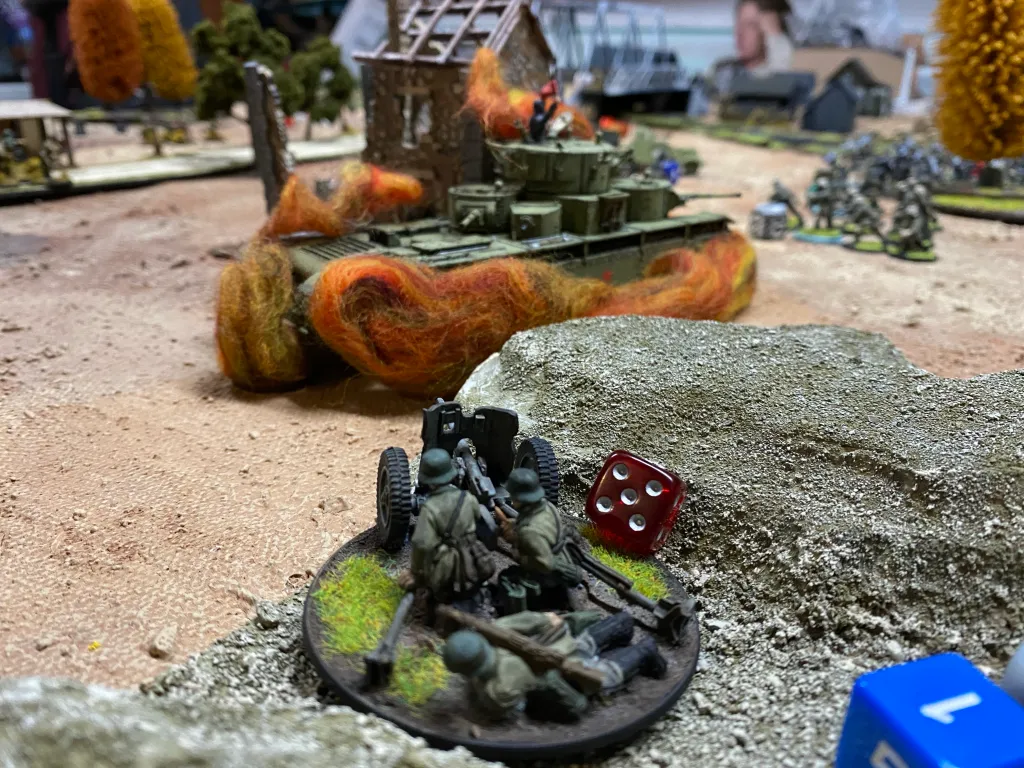
My favorite moment on the table, though, belongs to the Germans. I once spent five turns maneuvering a PaK 36 around the table on a long flanking mission, all for one shot: the rear armor of my friend’s T-28. It worked. Few things in this hobby feel better than a plan that slow finally paying off.
Why Bolt Action
Here’s the simplest reason I love Bolt Action: I’ve never really had an unfun game. National rules give each army its own flavor, but forces are generally well balanced, and most of my games come down to the wire.
People sometimes ask whether I prefer playing, painting or researching. Honestly, all three. The research gives the painting meaning, the painting brings the history to the table, and the games are where it all comes to life.
Orange County and What Comes Next
The Bolt Action scene here in Orange County has been great. There’s a lot of energy and a lot of talent. Running “Combat Patrol: The End of the Beginning,” a tournament using the Combat Patrol format pioneered by Chicago Dice, showed me there’s a real thirst for a dedicated, consistent group putting on events and themed league games.
Looking ahead, I’d love to see Warlord Games bring back campaign books with updated rules. At the top of my list is Burma. It was the longest campaign of the entire war, running from December 1941 to September 1945, and it’s still one of the least told.
Burma got under my skin while I was earning my master’s degree at San José State. I wrote a research paper there called “Chindits: Enduring the Unendurable.” The Chindits were Orde Wingate’s Long Range Penetration Groups, sent deep behind Japanese lines and kept alive by air drops, with mules hauling their gear through jungle and mountains. Wingate’s legacy is still argued over, and that argument tends to drown out the men who actually did the fighting. Their stories of comradeship and endurance in brutal conditions deserve a place in public memory alongside D-Day and the Pacific.
That’s exactly what a good campaign book can do. One of my dreams is to write the Burma campaign book for Bolt Action myself.
As for the community, I’d love to see an annual West Coast tournament or convention, centered right here in sunny Orange County, California.
Until then, keep an eye out for some Army Showcase articles, how to paint articles and some other goodies. Remember: keep the sand out of your weapons, keep those actions cleared, and I’ll see you on the beach!